2025
Livly: A curated live shopping experience powered by creators
Livly: A curated live shopping experience powered by creators
A boutique live shopping app designed around authenticity, calm, and confident discovery.
Every layout was tested across breakpoints, ensuring typography, spacing, and interaction patterns scaled seamlessly.
Accessibility considerations — such as contrast ratios and tap target sizes — were built into the base tokens, not treated as afterthoughts.
Overview
Live shopping is booming globally—but not in the U.S.
Despite massive investments, American users (especially Gen Z and younger Millennials) still view live shopping as:
Chaotic
pressure tactics, auction-style shouting
Untrustworthy
unknown sellers, unclear authenticity
Overwhelming
busy UI, fast chat, unclear product info
Low-quality
videos but no photos, lack of curation
Yet this same audience lives on influencer-driven platforms like TikTok, Instagram, and YouTube—where curated, personality-driven content drives their purchasing decisions every day.
Opportunity
Opportunity
There is no platform that treats influencers as curated, trustworthy hosts and live shopping as an elevated, boutique, editorial experience.
Livly fills this gap.
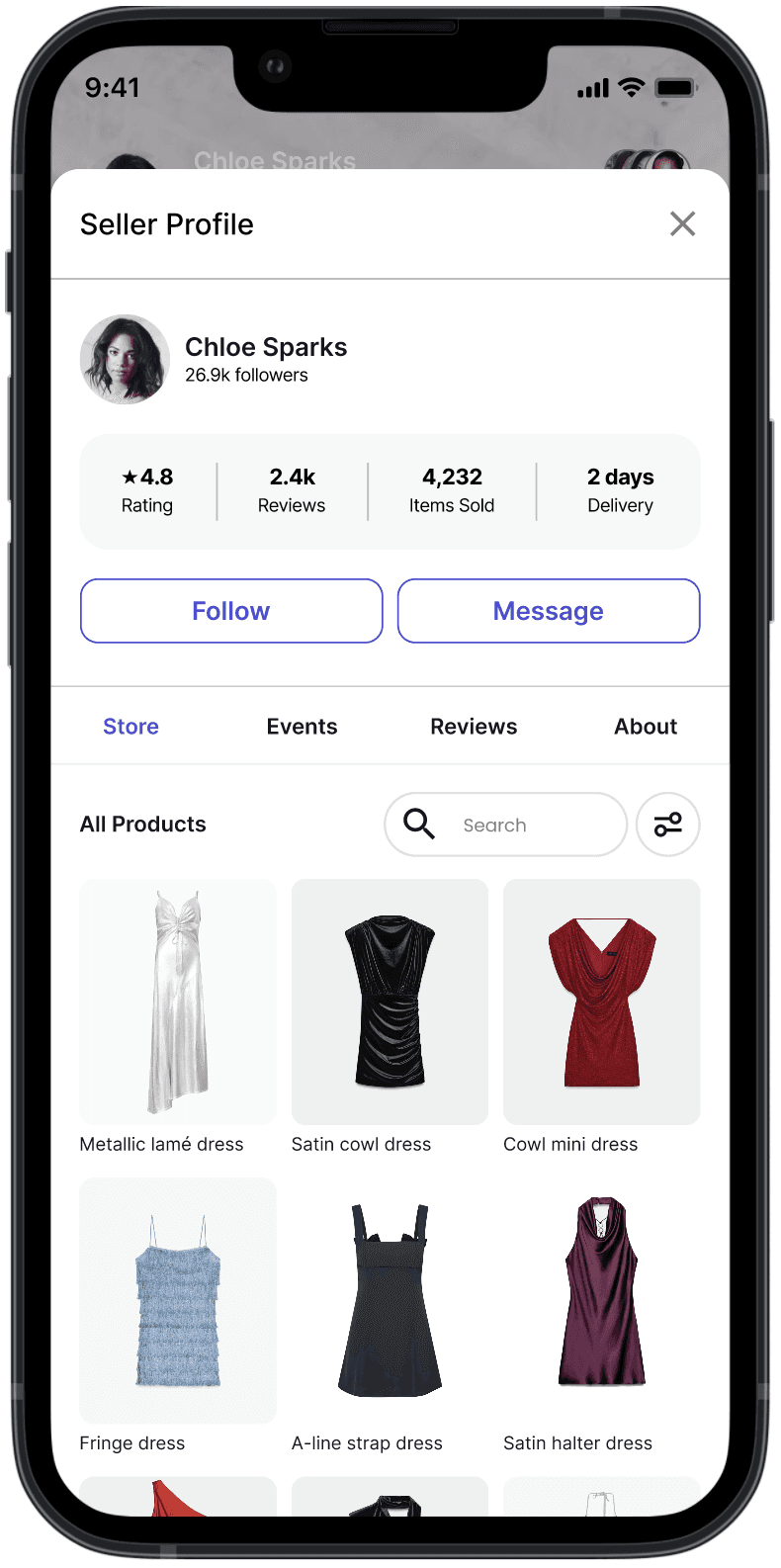
Defining The Core Problem
Defining The Core Problem
The challenge was to create a shared design language that felt unified under one system — yet adaptable enough for brands with contrasting aesthetics.
User Research
User Research
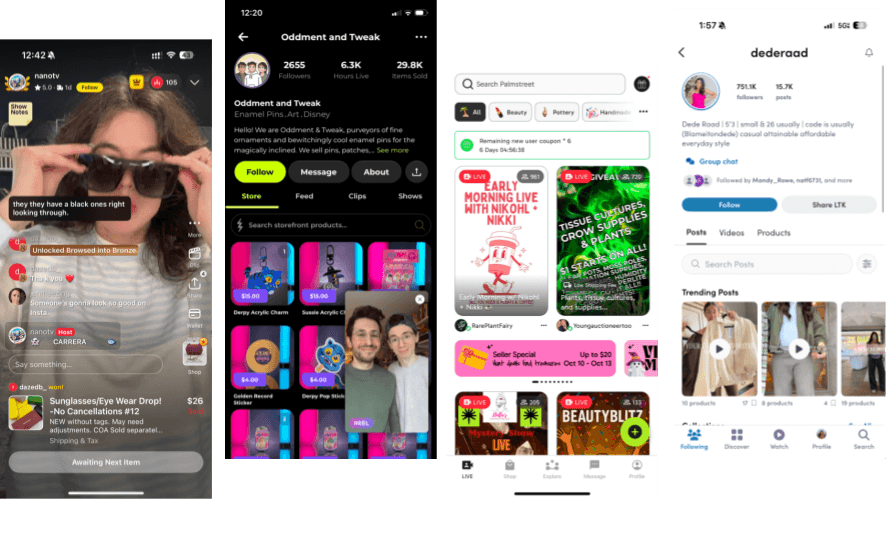
Competitive Analysis
What are other live shopping apps doing to:
Help sellers connect and interact with their buyers?
Navigate users through hundreds of live events and products?
Balance functionality and aesthetic?
What are they doing right? Doing wrong? How can we do better?
Learning About Our Users
6 Structured Interviews
(20–30 mins each)
2 Interview Scripts
(live shoppers + online shoppers)
15 Survey responses
collected over Goole forms
Affinity diagramming
to gather insights
Partcipant Demographics:
26-29 years old
Women
NYC/NJ based
Tech-savvy online shoppers whose fashion and lifestyle choices are influenced by digital creators.
67%
have watched live shopping events
33%
have purchased something from live shopping events
User Persona
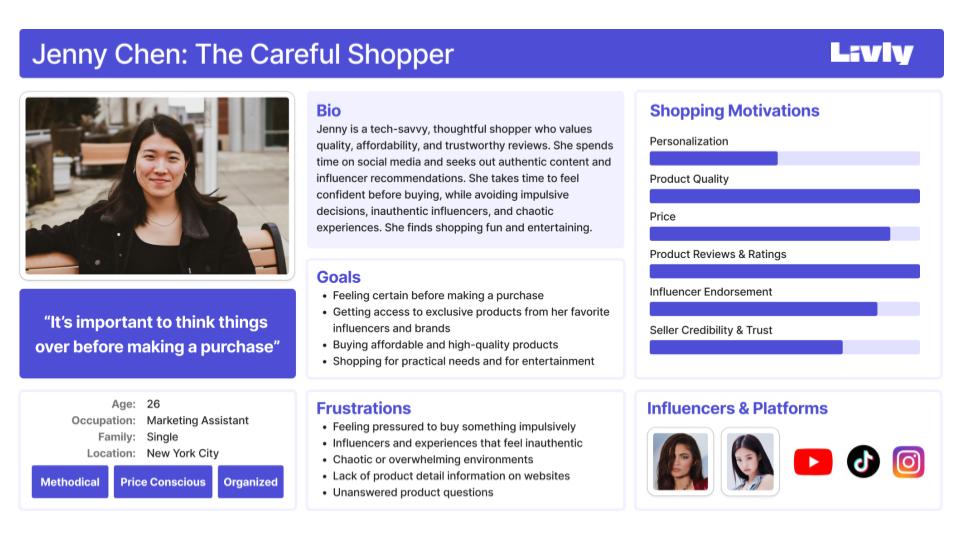
What Do Users Want
Trust Is Non-Negotiable
Users won’t engage or purchase without confidence in the platform, hosts, and products.
Avoid High-Pressure Selling
Users prefer excitement without stress or aggressive sales tactics.
Provide Clear Product Transparency
Users need reliable details like zoom-ins, replays, stills, reviews, and ratings before buying.
Deliver Relevant Guidance in Real Time
Users expect tailored recommendations and quick answers to their questions during live sessions.
Create a Premium,
Calm Experience
Users want an authentic, relationship-driven environment—not a chaotic one.
Leverage Influencer Connection
Users enjoy discovering products through creators they genuinely relate to.
Organising the Information
Organising the Information
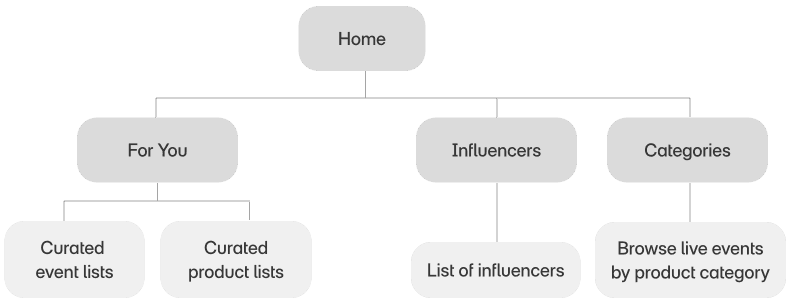
Information Architecture
We performed card sorting + tree testing to understand how users mentally group:
products, influencers, live interactions, seller credibility, shopping actions
What emerged:
Users weigh influencers and products equally when deciding what to explore next.
This shaped our final IA.
BEFORE
We’re on the right path for creating groups of information related to product details, interaction features, and seller information
Home
Curated
event lists
Curated
product lists
Discover
Browse live events
by influencer
Browse live events
by product category
+
AFTER
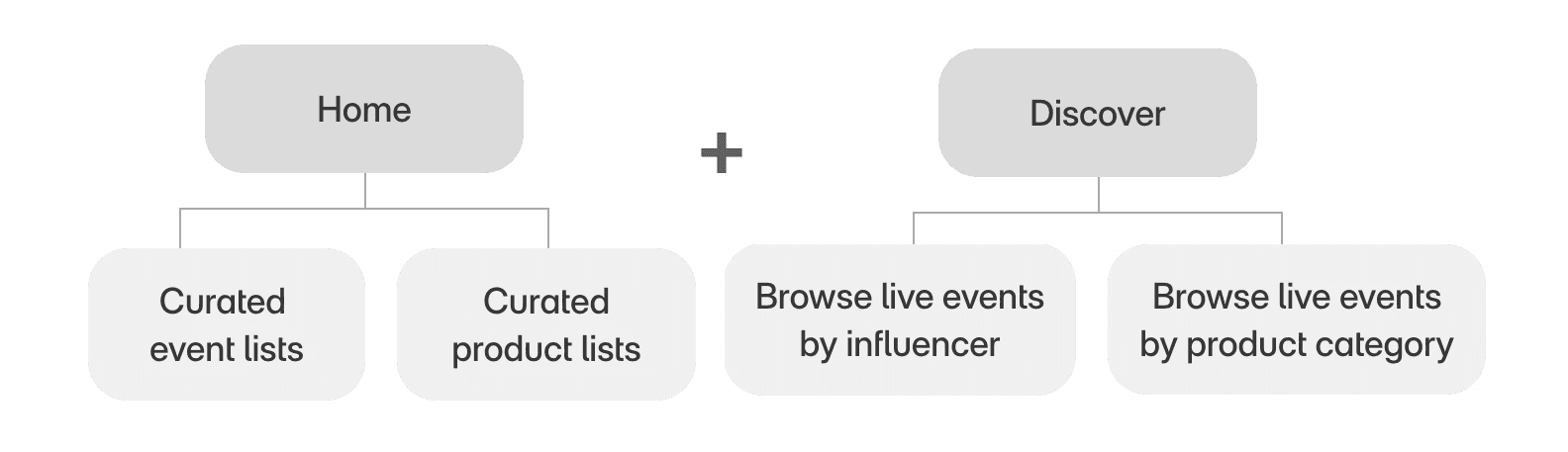
AFTER
We’re on the right path for creating groups of information related to product details, interaction features, and seller information
For You
Curated
event lists
Curated
product lists
Influencers
Home
List of influencers
Browse live events
by product category
Categories
Design
Design
Low-Fi Prototyping
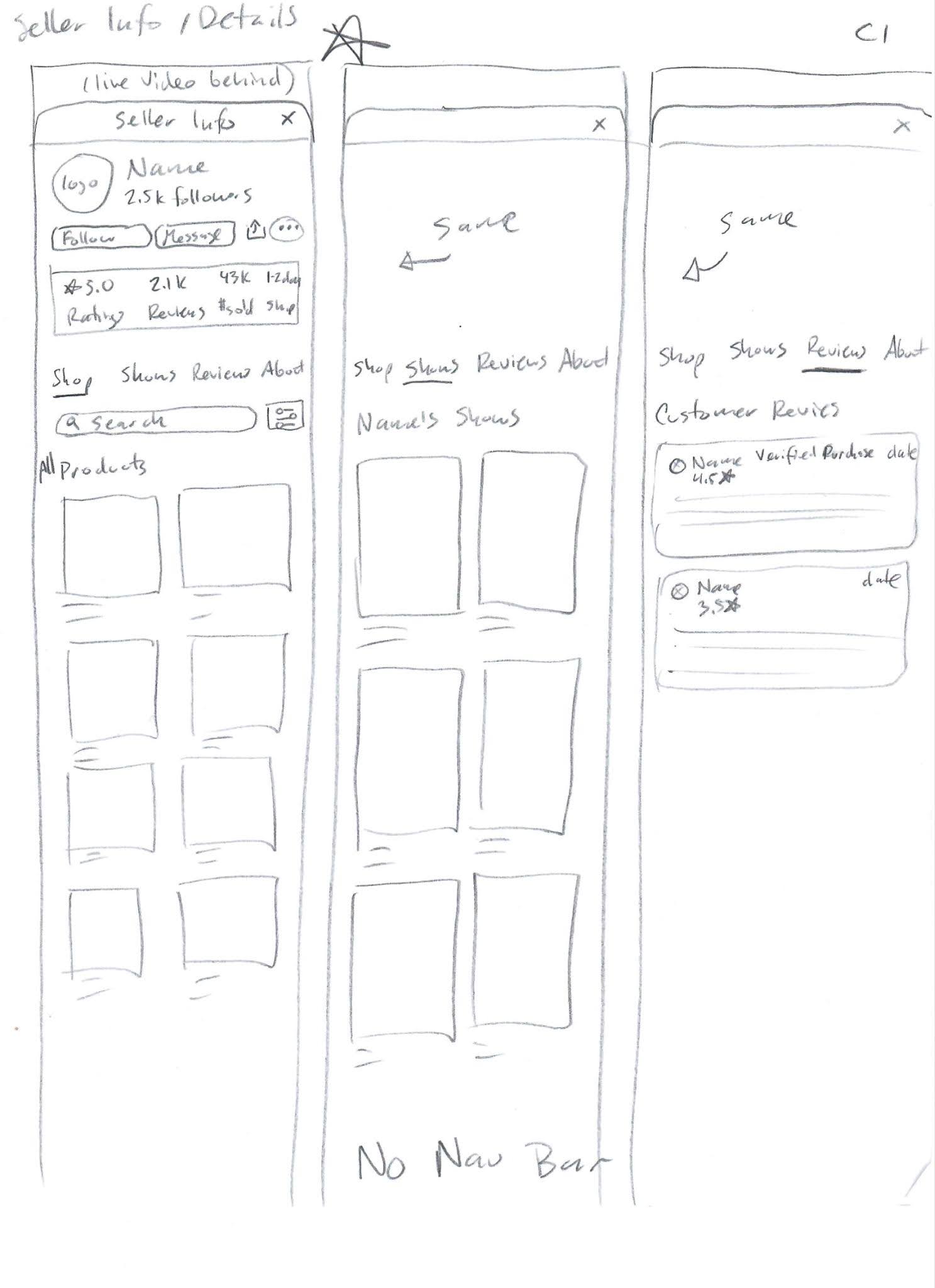
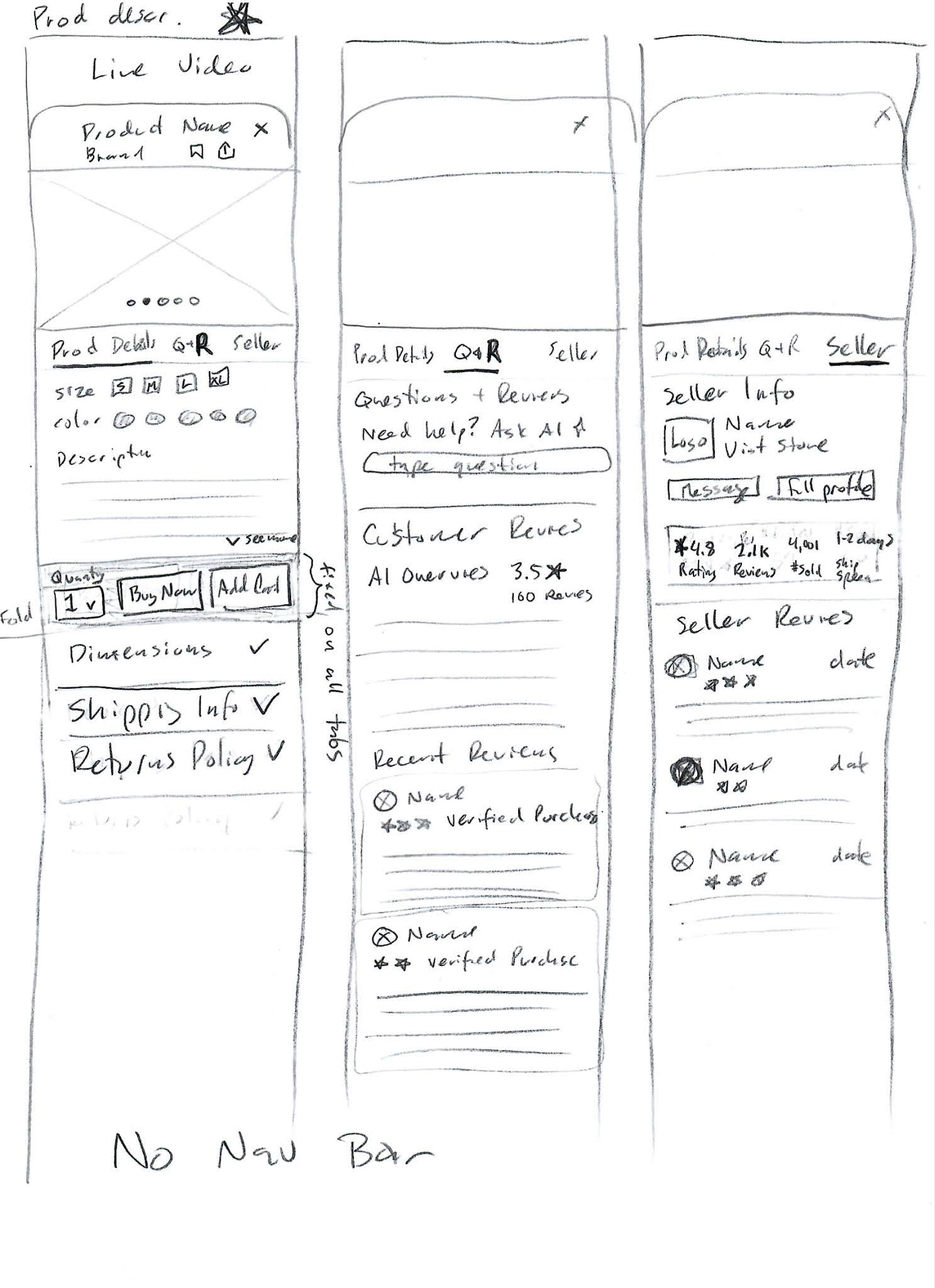
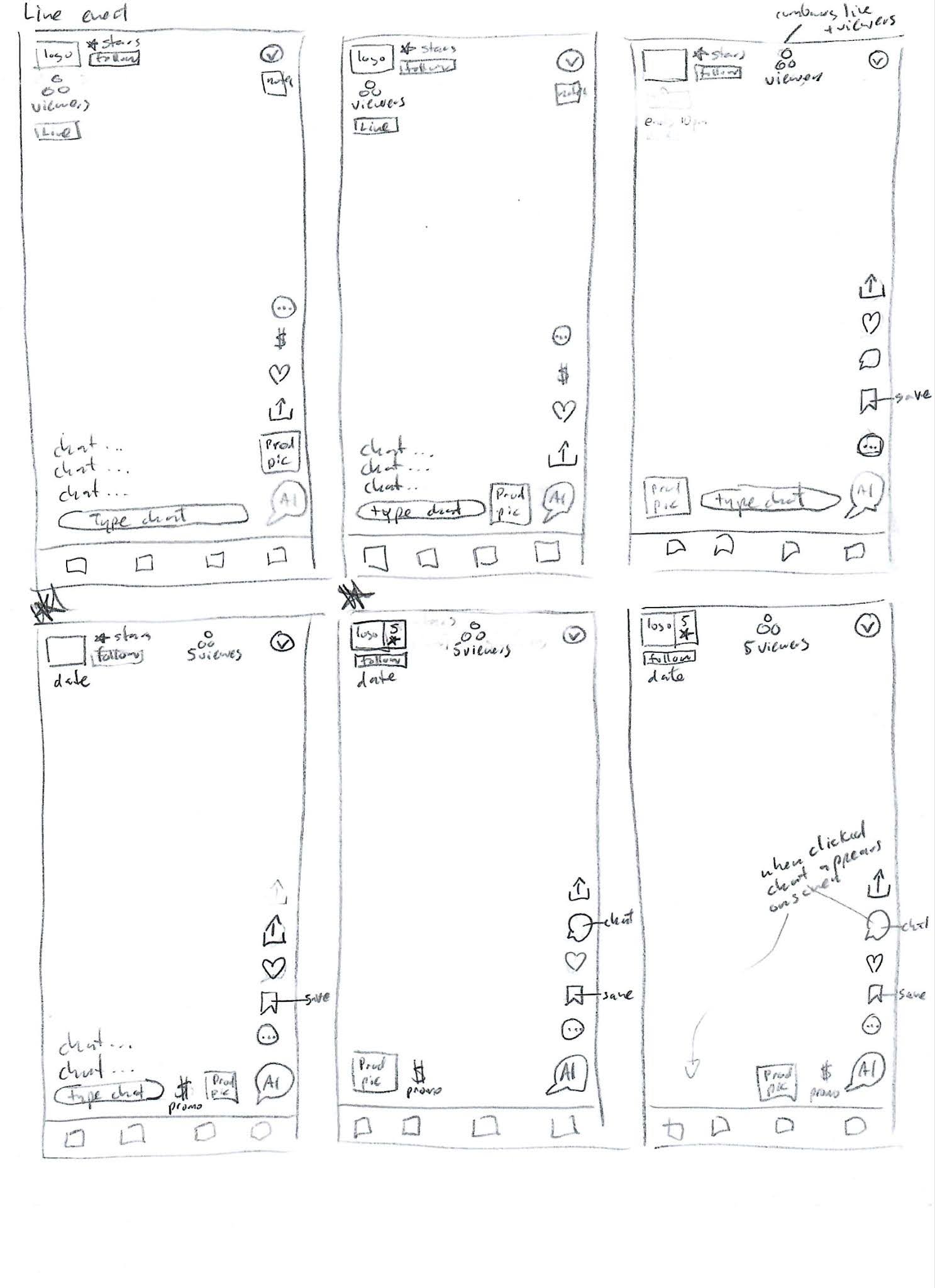
We started with sketches and designed a lo-fi prototype using our sitemap, ready for user testing
Evaluation
Evaluation
6 moderated user interviews.
1 task-based script
Three core flows:
Discover & purchase from a live event
Verify seller/influencer trustworthiness
Explore influencer’s full product range Livly Evaluation Results
Users liked:
Simplicity of layout
Clear navigation
Seller metrics and reviews
Product information
AI assistant
Users didn’t like/were confused by:
Live event icons
‘Your Edit’ tab and other content
Lack of stock indicators
No way to search through store
Missing chat on screen
Iterations
Iterations
Some Key Design Decisions
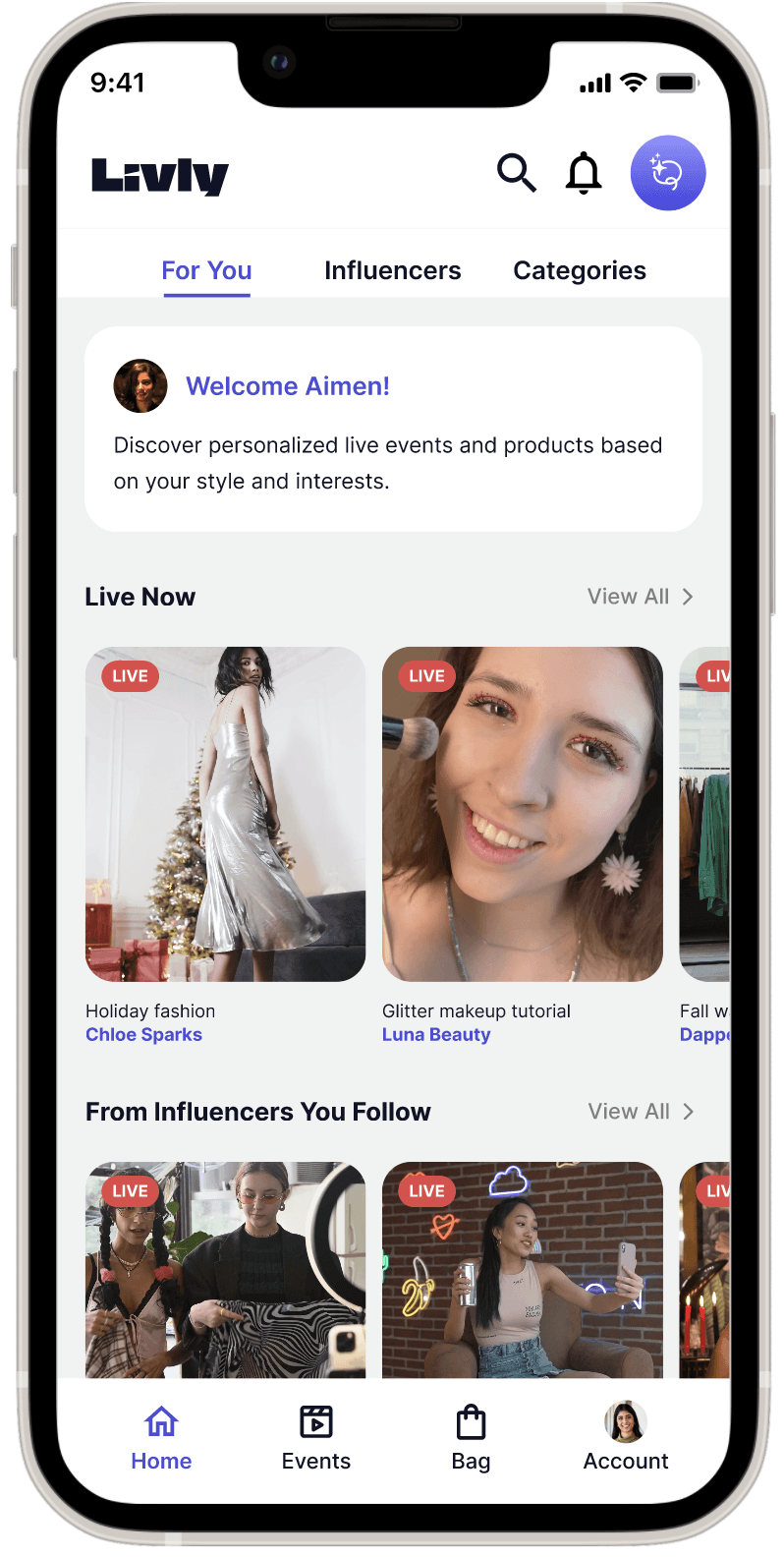
#1 All-in-one home page
User Research:
Users wanted a personalised feed but also the flexibility to browse creators or categories.
Lo-Fi Concept:
Introduced a home page with three tabs: Your Edit, Influencers, and Categories—defaulting to personalised content.
User Testing:
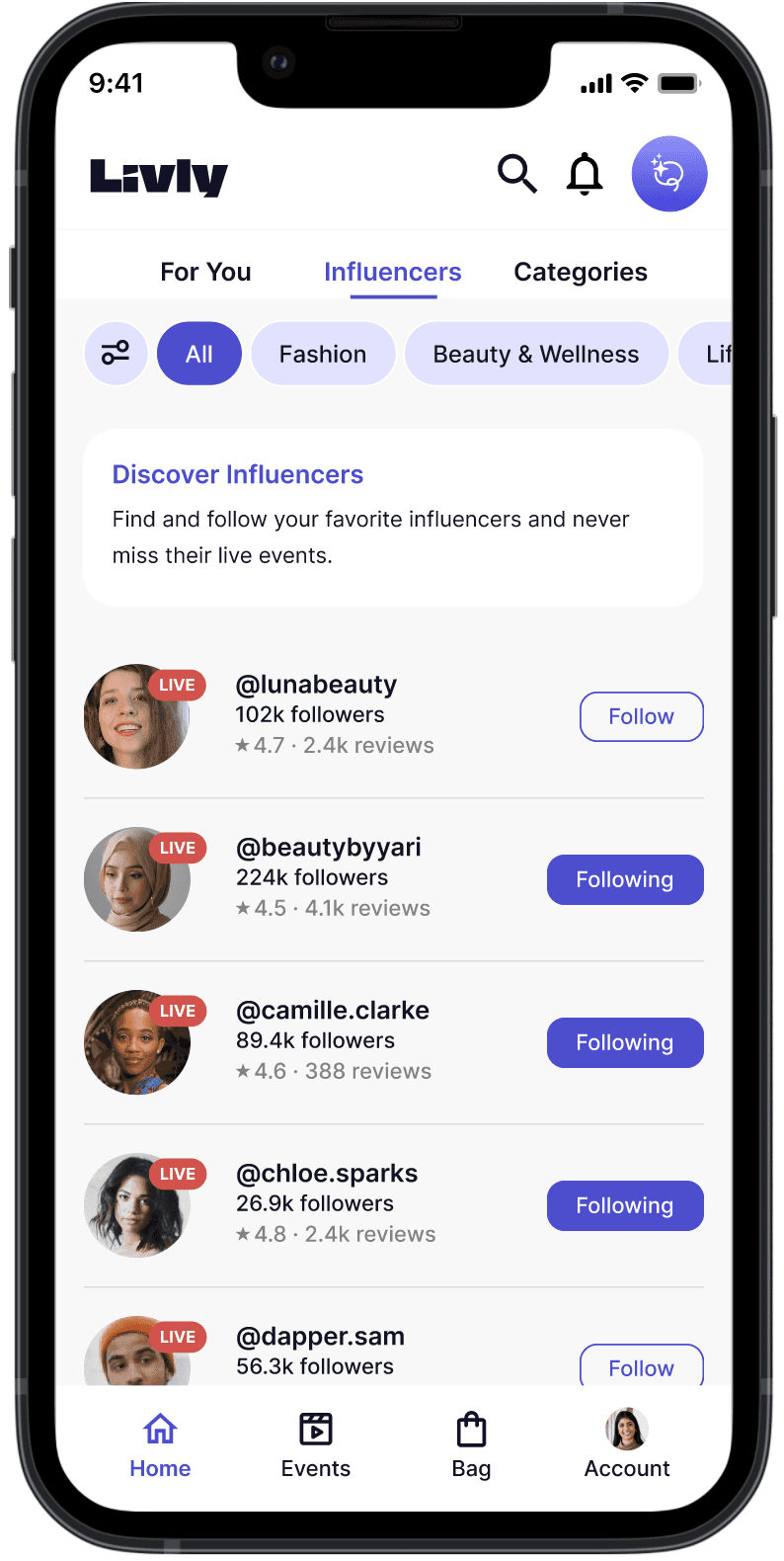
The label Your Edit implied users could customise the feed themselves. Additionally, tapping Influencers took users directly to live events, but they expected a list of creators first.
Final Decision:
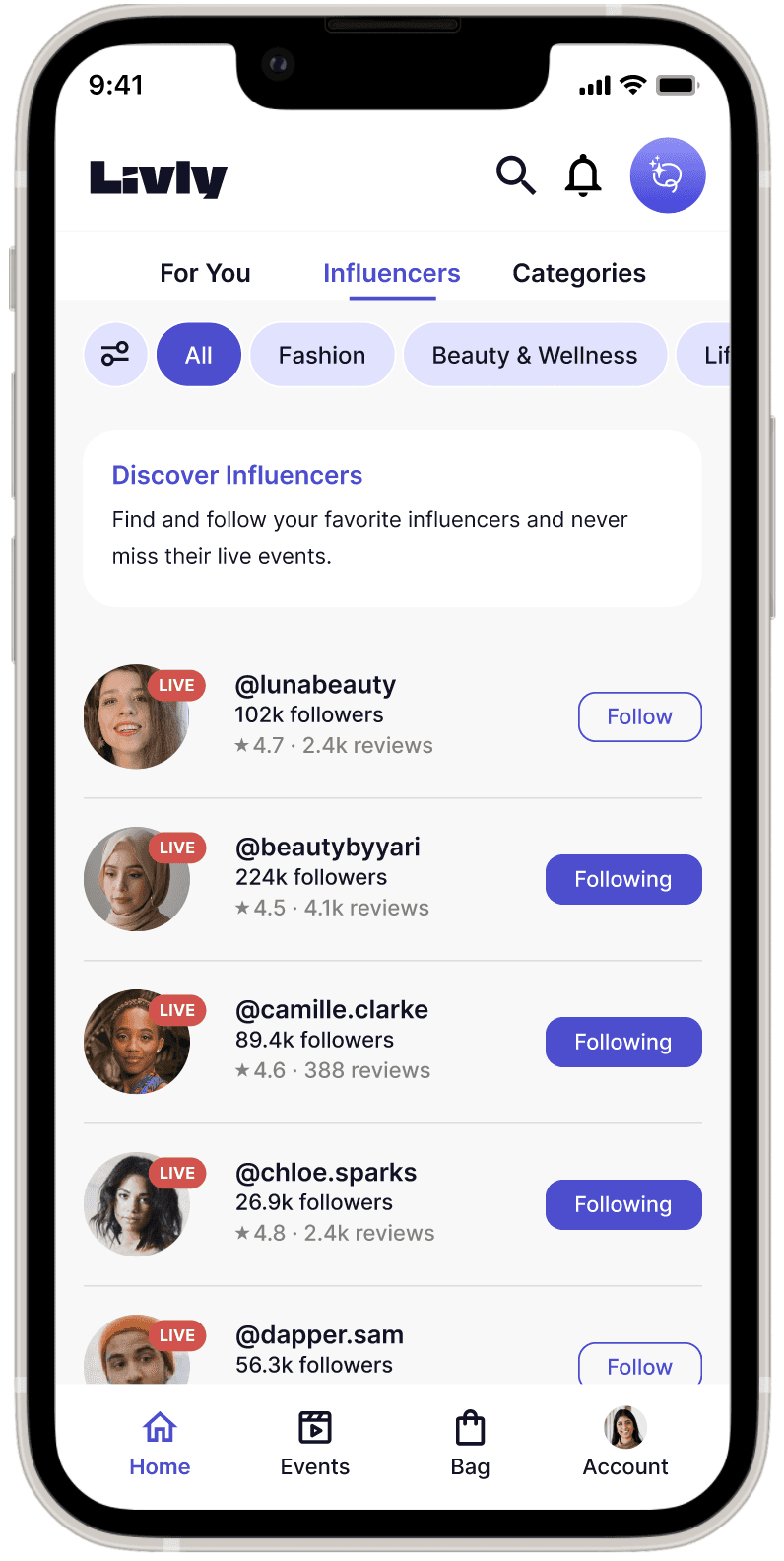
Renamed Your Edit to For You and redesigned Influencers to show a list of creators instead of immediately opening live events.
User Research:
Users wanted a personalised feed but also the flexibility to browse creators or categories.
Lo-Fi Concept:
Introduced a home page with three tabs: Your Edit, Influencers, and Categories—defaulting to personalised content.
User Testing:
The label Your Edit implied users could customise the feed themselves. Additionally, tapping Influencers took users directly to live events, but they expected a list of creators first.
Final Decision:
Renamed Your Edit to For You and redesigned Influencers to show a list of creators instead of immediately opening live events.
Lo-Fi Concept
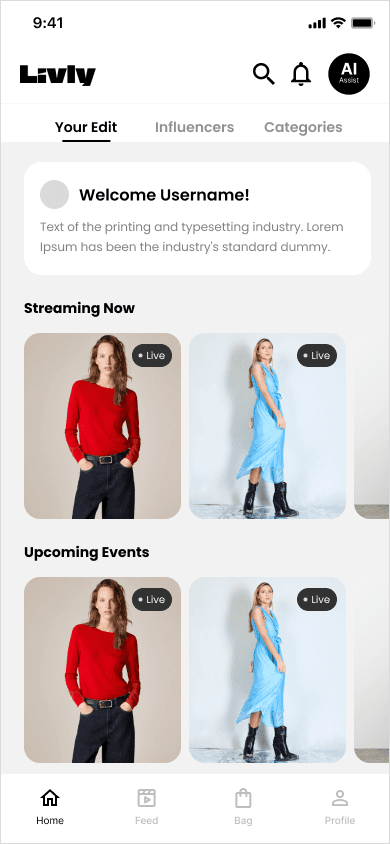
Influencers tab with live events
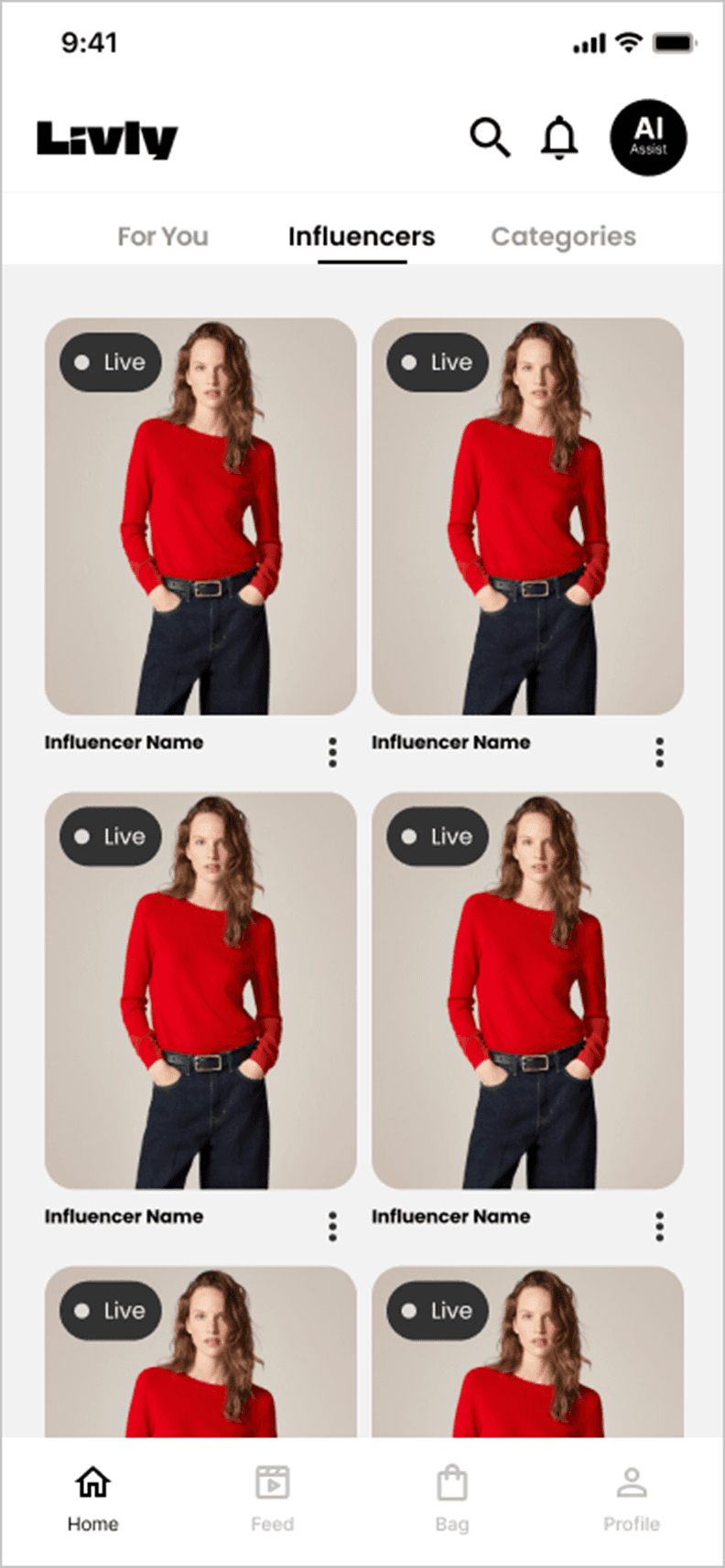
Revised Influencer Tab
#2 Engaging but unchaotic simple Live Screen
User Research:
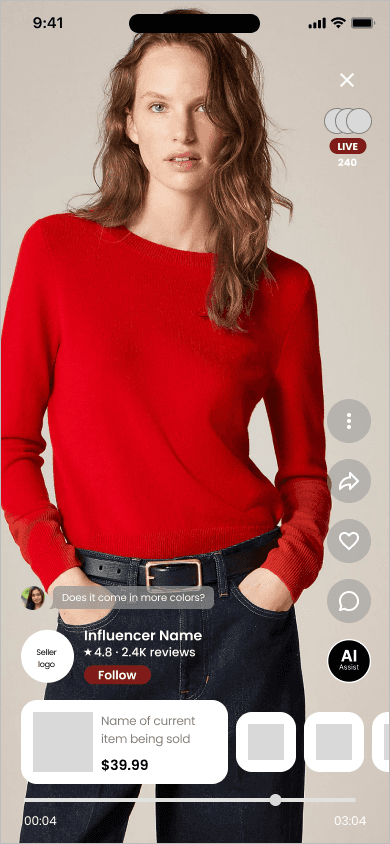
Users wanted quick-access features (comment, like, share, promos, save, product lineup) while avoiding a chaotic, chat-heavy live screen.
Lo-Fi Concept:
Added all requested features and nested the live chat to reduce clutter.
User Testing:
Too many icons led to confusion: the heart icon was interpreted as a wishlist, the save icon felt redundant, and the share icon resembled an upload action. Additionally, fully hiding the chat reduced user engagement.
Final Decision:
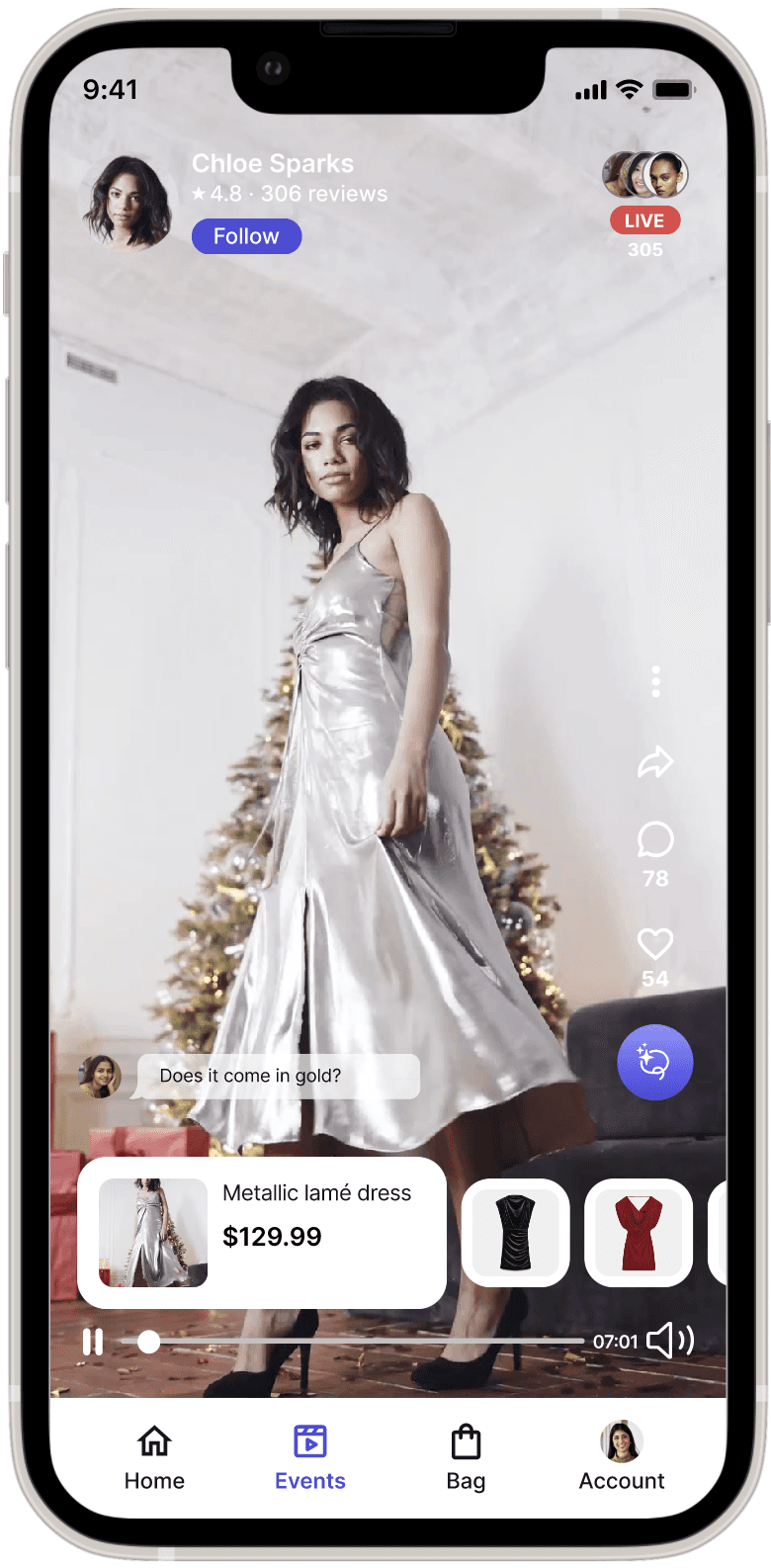
Removed redundant icons and kept only essential actions. Displayed one recent chat bubble on-screen while nesting the full chat in the comment icon.
Lo-Fi Concept
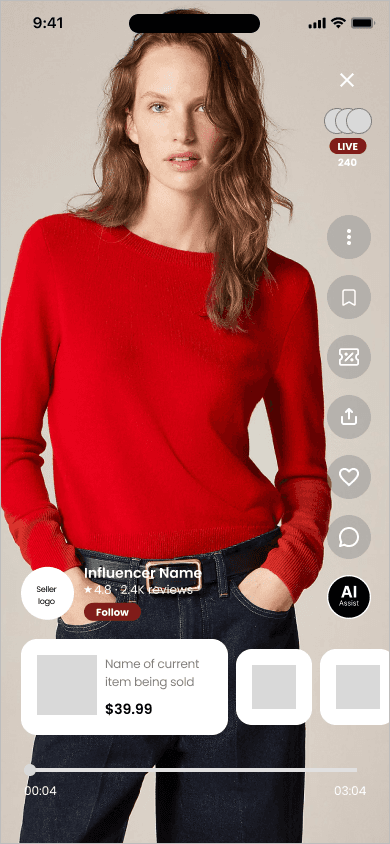
After User Testing
Final Prototype
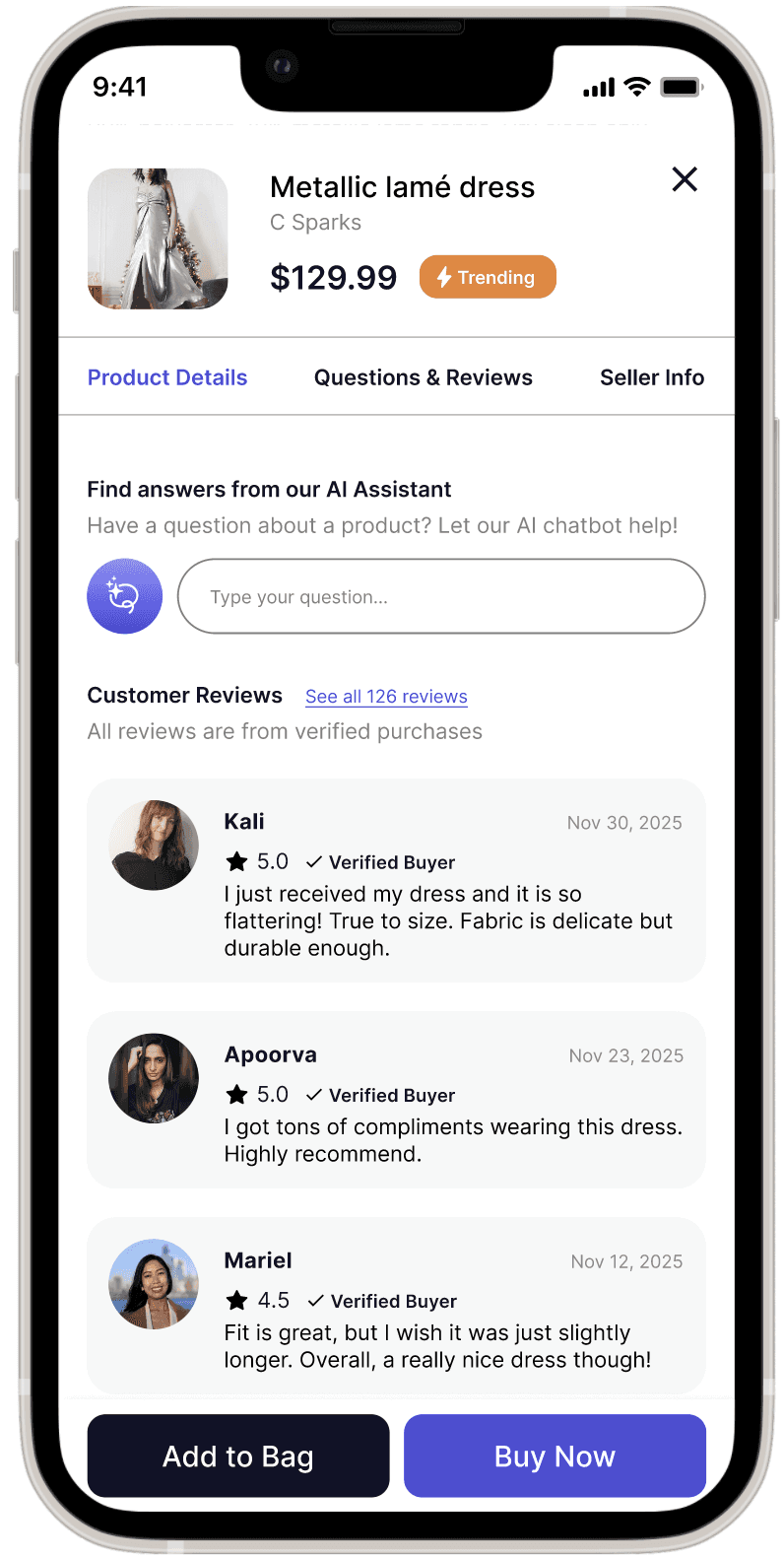
#3 Add to Cart / Buy Now
User Research:
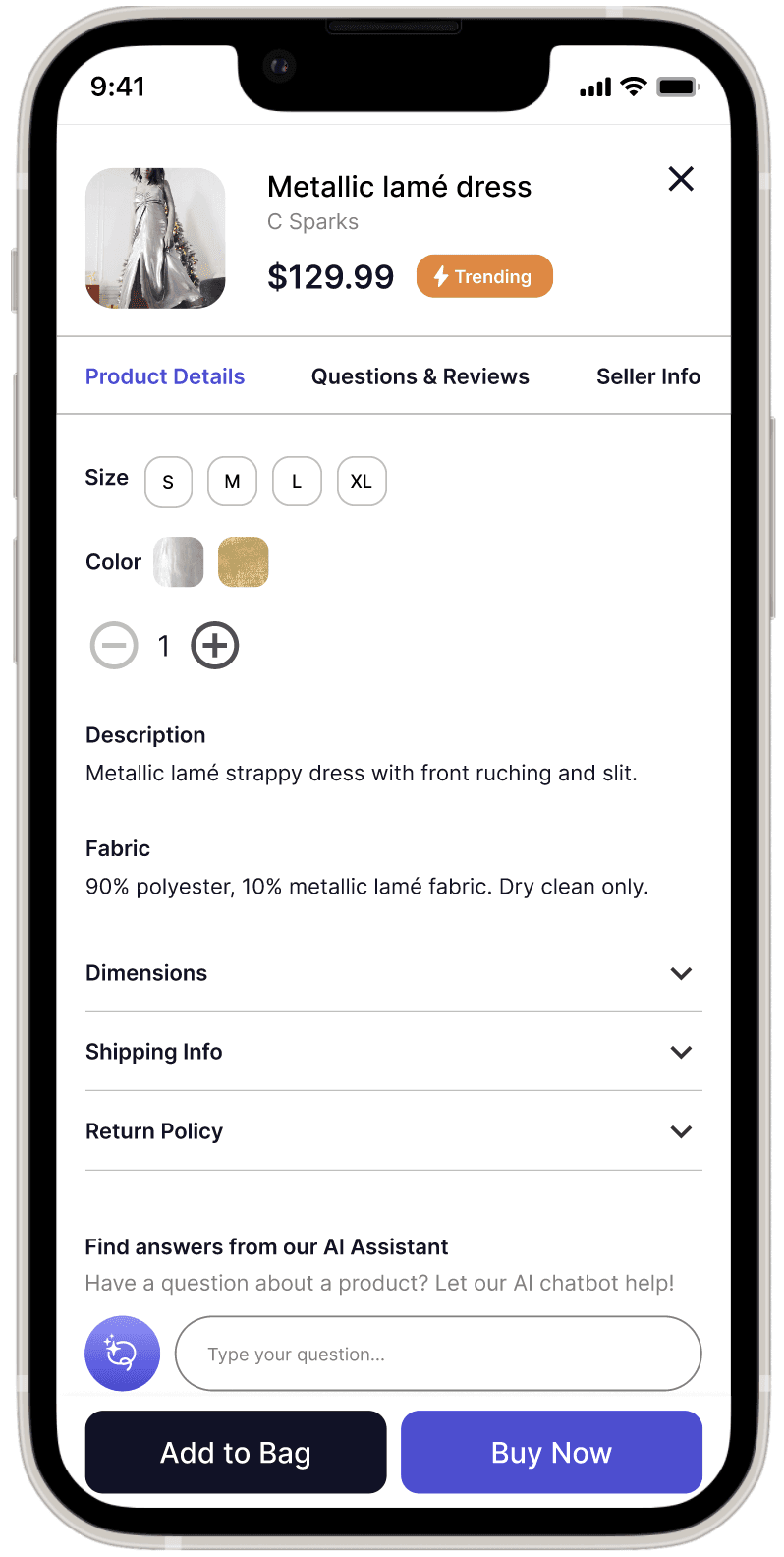
Users preferred a calm, non-pressured shopping experience and felt on-the-spot bidding was stressful.
Lo-Fi Concept:
Replaced bidding with prominent “Add to Cart” and “Buy Now” sticky buttons on the product details page.
User Testing:
This approach was validated—users responded positively to the simplified purchase flow.
Final Decision:
Implemented the two-button purchase model to support a more relaxed shopping experience.
No Live Bidding on Live Event
Sticky
Add to Cart/Buy Now
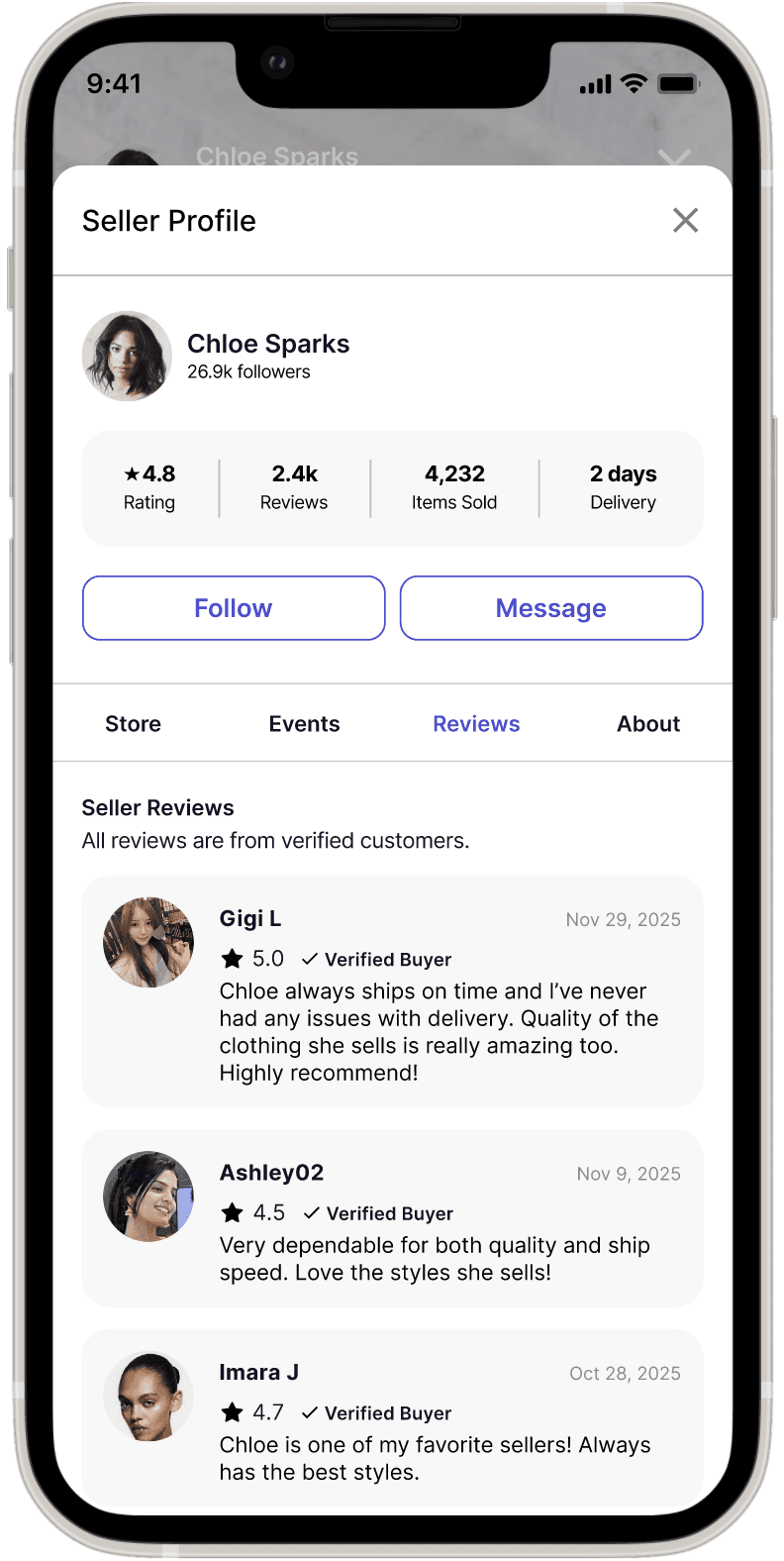
#4 Transparency via metrics & reviews
User Research:
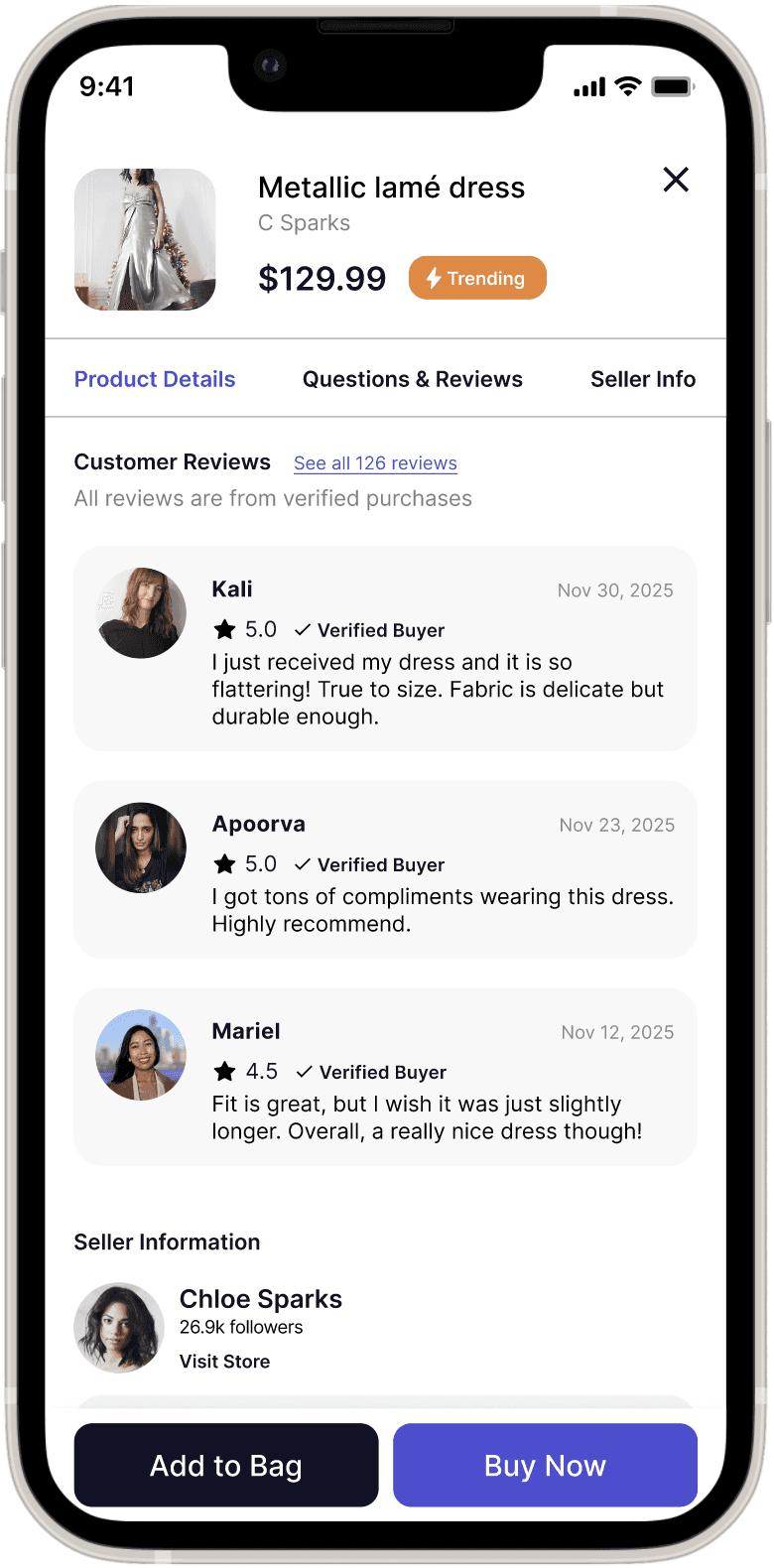
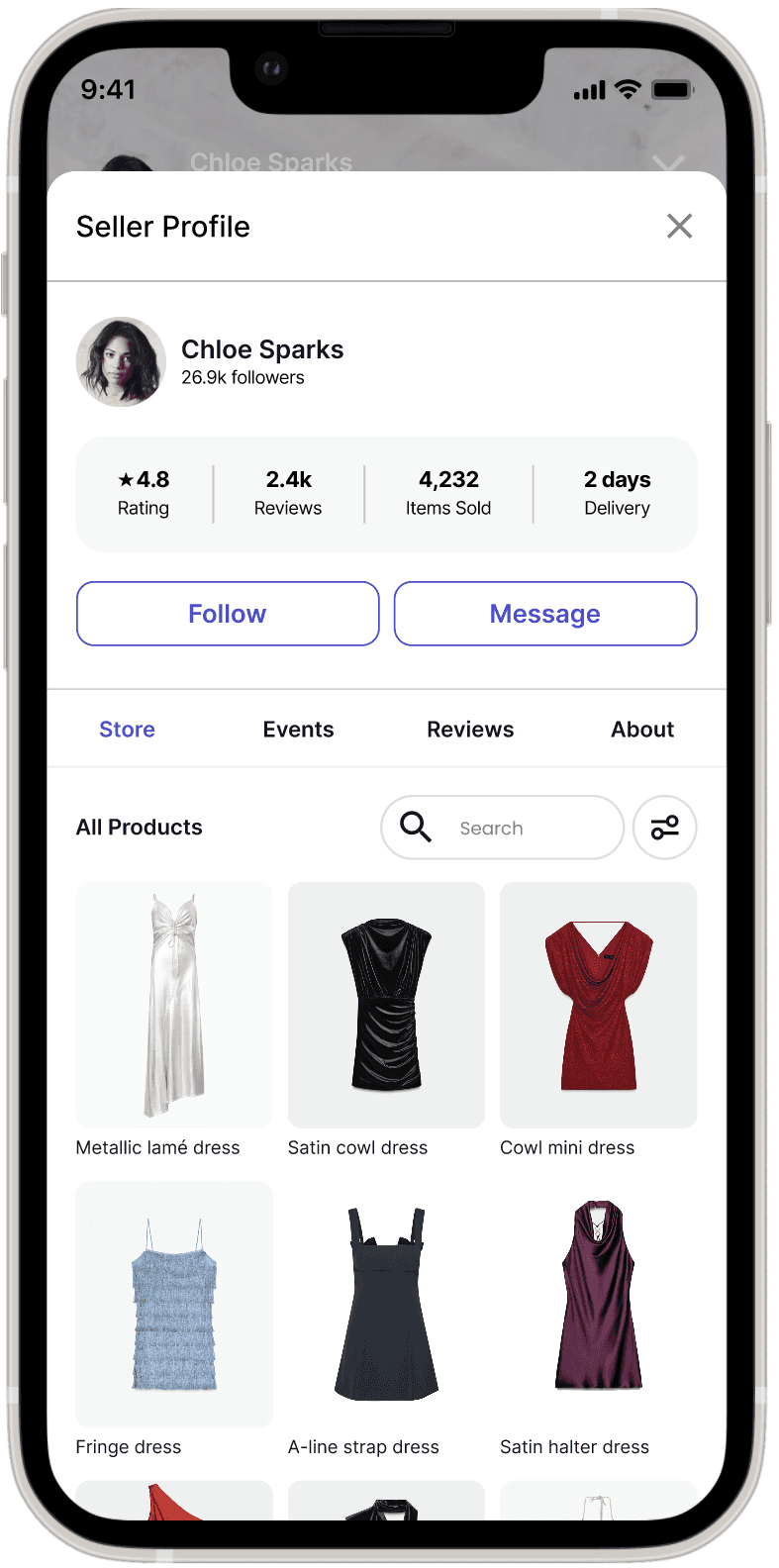
Users relied heavily on trust signals and wanted clarity on seller credibility before purchasing.
Lo-Fi Concept:
Introduced seller metrics such as ratings, past performance, and key stats, along with user reviews.
User Testing and Final Decision
Users found these indicators helpful which validated our design
Customer Reviews
Seller Metrics
Seller Reviews
#5 AI Assistant Integration
User Research:
Users struggled to interact with sellers during busy live sessions, especially for returns and refund-related questions.
Lo-Fi Concept:
Added an AI assistant on the live screen that could summarise key information and answer common queries.
User Testing & Final Decision:
Users appreciated the feature, validating its inclusion as a support layer during live shopping.
Home
Live Event
Product Details
The Result
The Result
A premium, calm, curated live shopping experience
Strong emphasis on influencers as trusted curators, not sales agents
Clear, structured product details to reduce anxiety
Trust signals integrated across seller and influencer profiles
A final high-fidelity prototype that users described as:“so clean,” “trustworthy,” “like a boutique I want to shop from.”
Market Gap Solved
Livly fills the void between:
TikTok aesthetics × Nordstrom product trust × real-time influencer connection.
More Works
More Works
Overview
Every layout was tested across breakpoints, ensuring typography, spacing, and interaction patterns scaled seamlessly.
Accessibility considerations — such as contrast ratios and tap target sizes — were built into the base tokens, not treated as afterthoughts.
Chaotic
pressure tactics, auction-style shouting
Untrustworthy
unknown sellers, unclear authenticity
Overwhelming
busy UI, fast chat, unclear product info
Low-quality
videos but no photos, lack of curation
Yet this same audience lives on influencer-driven platforms like TikTok, Instagram, and YouTube—where curated, personality-driven content drives their purchasing decisions every day.
Opportunity
There is no platform that treats influencers as curated, trustworthy hosts and live shopping as an elevated, boutique, editorial experience.
Livly fills this gap.
Defining The Core Problem
The challenge was to create a shared design language that felt unified under one system — yet adaptable enough for brands with contrasting aesthetics.
User Research
Competitive Analysis
What are other live shopping apps doing to:
Help sellers connect and interact with their buyers?
Navigate users through hundreds of live events and products?
Balance functionality and aesthetic?
What are they doing right? Doing wrong? How can we do better?
Learning About Our Users
6 Structured Interviews
(20–30 mins each)
2 Interview Scripts
(live shoppers + online shoppers)
15 Survey responses
collected over Goole forms
Affinity diagramming
to gather insights
Partcipant Demographics:
26-29 years old
Women
NYC/NJ based
Tech-savvy online shoppers whose fashion and lifestyle choices are influenced by digital creators.
67%
have watched live shopping events
33%
have purchased something from live shopping events
User Persona
What Do Users Want
Trust Is Non-Negotiable
Users won’t engage or purchase without confidence in the platform, hosts, and products.
Avoid High-Pressure Selling
Users prefer excitement without stress or aggressive sales tactics.
Provide Clear Product Transparency
Users need reliable details like zoom-ins, replays, stills, reviews, and ratings before buying.
Deliver Relevant Guidance in Real Time
Users expect tailored recommendations and quick answers to their questions during live sessions.
Create a Premium,
Calm Experience
Users want an authentic, relationship-driven environment—not a chaotic one.
Leverage Influencer Connection
Users enjoy discovering products through creators they genuinely relate to.
Organising the Information
Information Architecture
We performed card sorting + tree testing to understand how users mentally group:
products, influencers, live interactions, seller credibility, shopping actions
What emerged:
Users weigh influencers and products equally when deciding what to explore next.
This shaped our final IA.
BEFORE
We’re on the right path for creating groups of information related to product details, interaction features, and seller information
AFTER
We’re on the right path for creating groups of information related to product details, interaction features, and seller information
Design
Low-Fi Prototyping
We started with sketches and designed a lo-fi prototype using our sitemap, ready for user testing
Evaluation
6 moderated user interviews.
1 task-based script
Three core flows:
Discover & purchase from a live event
Verify seller/influencer trustworthiness
Explore influencer’s full product range Livly Evaluation Results
Users liked:
Simplicity of layout
Clear navigation
Seller metrics and reviews
Product information
AI assistant
Users didn’t like/were confused by:
Live event icons
‘Your Edit’ tab and other content
Lack of stock indicators
No way to search through store
Missing chat on screen
Iterations
Some Key Design Decisions
#1 All-in-one home page
User Research:
Users wanted a personalised feed but also the flexibility to browse creators or categories.
Lo-Fi Concept:
Introduced a home page with three tabs: Your Edit, Influencers, and Categories—defaulting to personalised content.
User Testing:
The label Your Edit implied users could customise the feed themselves. Additionally, tapping Influencers took users directly to live events, but they expected a list of creators first.
Final Decision:
Renamed Your Edit to For You and redesigned Influencers to show a list of creators instead of immediately opening live events.
Lo-Fi Concept
Influencers tab with live events
Revised Influencer Tab
#2 Engaging but unchaotic simple Live Screen
User Research:
Users wanted quick-access features (comment, like, share, promos, save, product lineup) while avoiding a chaotic, chat-heavy live screen.
Lo-Fi Concept:
Added all requested features and nested the live chat to reduce clutter.
User Testing:
Too many icons led to confusion: the heart icon was interpreted as a wishlist, the save icon felt redundant, and the share icon resembled an upload action. Additionally, fully hiding the chat reduced user engagement.
Final Decision:
Removed redundant icons and kept only essential actions. Displayed one recent chat bubble on-screen while nesting the full chat in the comment icon.
Lo-Fi Concept
After User Testing
Final Prototype
#3 Add to Cart / Buy Now
User Research:
Users preferred a calm, non-pressured shopping experience and felt on-the-spot bidding was stressful.
Lo-Fi Concept:
Replaced bidding with prominent “Add to Cart” and “Buy Now” sticky buttons on the product details page.
User Testing:
This approach was validated—users responded positively to the simplified purchase flow.
Final Decision:
Implemented the two-button purchase model to support a more relaxed shopping experience.
No Live Bidding on Live Event
Sticky
Add to Cart/Buy Now
#4 Transparency via metrics & reviews
User Research:
Users relied heavily on trust signals and wanted clarity on seller credibility before purchasing.
Lo-Fi Concept:
Introduced seller metrics such as ratings, past performance, and key stats, along with user reviews.
User Testing and Final Decision
Users found these indicators helpful which validated our design
Customer Reviews
Seller Metrics
Seller Reviews
#5 AI Assistant Integration
User Research:
Users struggled to interact with sellers during busy live sessions, especially for returns and refund-related questions.
Lo-Fi Concept:
Added an AI assistant on the live screen that could summarise key information and answer common queries.
User Testing & Final Decision:
Users appreciated the feature, validating its inclusion as a support layer during live shopping.
Home
Live Event
Product Details
The Result
From the start, the system was engineered for mobile-first experiences.
A premium, calm, curated live shopping experience
Strong emphasis on influencers as trusted curators, not sales agents
Clear, structured product details to reduce anxiety
Trust signals integrated across seller and influencer profiles
A final high-fidelity prototype that users described as:“so clean,” “trustworthy,” “like a boutique I want to shop from.”
Market Gap Solved
Livly fills the void between:
TikTok aesthetics × Nordstrom product trust × real-time influencer connection.
More Works
2025
Livly: A curated live shopping experience powered by creators
A boutique live shopping app designed around authenticity, calm, and confident discovery.
Every layout was tested across breakpoints, ensuring typography, spacing, and interaction patterns scaled seamlessly.
Accessibility considerations — such as contrast ratios and tap target sizes — were built into the base tokens, not treated as afterthoughts.
Overview
Live shopping is booming globally—but not in the U.S.
Despite massive investments, American users (especially Gen Z and younger Millennials) still view live shopping as:
Chaotic
pressure tactics, auction-style shouting
Untrustworthy
unknown sellers, unclear authenticity
Overwhelming
busy UI, fast chat, unclear product info
Low-quality
videos but no photos, lack of curation
Yet this same audience lives on influencer-driven platforms like TikTok, Instagram, and YouTube—where curated, personality-driven content drives their purchasing decisions every day.
Opportunity
There is no platform that treats influencers as curated, trustworthy hosts and live shopping as an elevated, boutique, editorial experience.
Livly fills this gap.
Defining The Core Problem
The challenge was to create a shared design language that felt unified under one system — yet adaptable enough for brands with contrasting aesthetics.
User Research
Competitive Analysis
What are other live shopping apps doing to:
Help sellers connect and interact with their buyers?
Navigate users through hundreds of live events and products?
Balance functionality and aesthetic?
What are they doing right? Doing wrong? How can we do better?
Learning About Our Users
6 Structured Interviews
(20–30 mins each)
2 Interview Scripts
(live shoppers + online shoppers)
15 Survey responses
collected over Goole forms
Affinity diagramming
to gather insights
Partcipant Demographics:
26-29 years old
Women
NYC/NJ based
Tech-savvy online shoppers whose fashion and lifestyle choices are influenced by digital creators.
67%
have watched live shopping events
33%
have purchased something from live shopping events
User Persona
What Do Users Want
Trust Is Non-Negotiable
Users won’t engage or purchase without confidence in the platform, hosts, and products.
Avoid High-Pressure Selling
Users prefer excitement without stress or aggressive sales tactics.
Provide Clear Product Transparency
Users need reliable details like zoom-ins, replays, stills, reviews, and ratings before buying.
Deliver Relevant Guidance in Real Time
Users expect tailored recommendations and quick answers to their questions during live sessions.
Create a Premium,
Calm Experience
Users want an authentic, relationship-driven environment—not a chaotic one.
Leverage Influencer Connection
Users enjoy discovering products through creators they genuinely relate to.
Organising the Information
Information Architecture
We performed card sorting + tree testing to understand how users mentally group:
products, influencers, live interactions, seller credibility, shopping actions
What emerged:
Users weigh influencers and products equally when deciding what to explore next.
This shaped our final IA.
BEFORE
We’re on the right path for creating groups of information related to product details, interaction features, and seller information
Home
Curated
event lists
Curated
product lists
Discover
Browse live events
by influencer
Browse live events
by product category
+
AFTER
AFTER
We’re on the right path for creating groups of information related to product details, interaction features, and seller information
For You
Curated
event lists
Curated
product lists
Influencers
Home
List of influencers
Browse live events
by product category
Categories
Design
Low-Fi Prototyping
We started with sketches and designed a lo-fi prototype using our sitemap, ready for user testing
Evaluation
6 moderated user interviews.
1 task-based script
Three core flows:
Discover & purchase from a live event
Verify seller/influencer trustworthiness
Explore influencer’s full product range Livly Evaluation Results
Users liked:
Simplicity of layout
Clear navigation
Seller metrics and reviews
Product information
AI assistant
Users didn’t like/were confused by:
Live event icons
‘Your Edit’ tab and other content
Lack of stock indicators
No way to search through store
Missing chat on screen
Iterations
Some Key Design Decisions
#1 All-in-one home page
User Research:
Users wanted a personalised feed but also the flexibility to browse creators or categories.
Lo-Fi Concept:
Introduced a home page with three tabs: Your Edit, Influencers, and Categories—defaulting to personalised content.
User Testing:
The label Your Edit implied users could customise the feed themselves. Additionally, tapping Influencers took users directly to live events, but they expected a list of creators first.
Final Decision:
Renamed Your Edit to For You and redesigned Influencers to show a list of creators instead of immediately opening live events.
Lo-Fi Concept
Influencers tab with live events
Revised Influencer Tab
#2 Engaging but unchaotic simple Live Screen
User Research:
Users wanted quick-access features (comment, like, share, promos, save, product lineup) while avoiding a chaotic, chat-heavy live screen.
Lo-Fi Concept:
Added all requested features and nested the live chat to reduce clutter.
User Testing:
Too many icons led to confusion: the heart icon was interpreted as a wishlist, the save icon felt redundant, and the share icon resembled an upload action. Additionally, fully hiding the chat reduced user engagement.
Final Decision:
Removed redundant icons and kept only essential actions. Displayed one recent chat bubble on-screen while nesting the full chat in the comment icon.
Lo-Fi Concept
After User Testing
Final Prototype
#3 Add to Cart / Buy Now
User Research:
Users preferred a calm, non-pressured shopping experience and felt on-the-spot bidding was stressful.
Lo-Fi Concept:
Replaced bidding with prominent “Add to Cart” and “Buy Now” sticky buttons on the product details page.
User Testing:
This approach was validated—users responded positively to the simplified purchase flow.
Final Decision:
Implemented the two-button purchase model to support a more relaxed shopping experience.
No Live Bidding on Live Event
Sticky
Add to Cart/Buy Now
#4 Transparency via metrics & reviews
User Research:
Users relied heavily on trust signals and wanted clarity on seller credibility before purchasing.
Lo-Fi Concept:
Introduced seller metrics such as ratings, past performance, and key stats, along with user reviews.
User Testing and Final Decision
Users found these indicators helpful which validated our design
Customer Reviews
Seller Metrics
Seller Reviews
#5 AI Assistant Integration
User Research:
Users struggled to interact with sellers during busy live sessions, especially for returns and refund-related questions.
Lo-Fi Concept:
Added an AI assistant on the live screen that could summarise key information and answer common queries.
User Testing & Final Decision:
Users appreciated the feature, validating its inclusion as a support layer during live shopping.
Home
Live Event
Product Details
The Result
A premium, calm, curated live shopping experience
Strong emphasis on influencers as trusted curators, not sales agents
Clear, structured product details to reduce anxiety
Trust signals integrated across seller and influencer profiles
A final high-fidelity prototype that users described as:“so clean,” “trustworthy,” “like a boutique I want to shop from.”
Market Gap Solved
Livly fills the void between:
TikTok aesthetics × Nordstrom product trust × real-time influencer connection.
More Works
Overview
Every layout was tested across breakpoints, ensuring typography, spacing, and interaction patterns scaled seamlessly.
Accessibility considerations — such as contrast ratios and tap target sizes — were built into the base tokens, not treated as afterthoughts.
Chaotic
pressure tactics, auction-style shouting
Untrustworthy
unknown sellers, unclear authenticity
Overwhelming
busy UI, fast chat, unclear product info
Low-quality
videos but no photos, lack of curation
Yet this same audience lives on influencer-driven platforms like TikTok, Instagram, and YouTube—where curated, personality-driven content drives their purchasing decisions every day.
Opportunity
There is no platform that treats influencers as curated, trustworthy hosts and live shopping as an elevated, boutique, editorial experience.
Livly fills this gap.
Defining The Core Problem
The challenge was to create a shared design language that felt unified under one system — yet adaptable enough for brands with contrasting aesthetics.
User Research
Competitive Analysis
What are other live shopping apps doing to:
Help sellers connect and interact with their buyers?
Navigate users through hundreds of live events and products?
Balance functionality and aesthetic?
What are they doing right? Doing wrong? How can we do better?
Learning About Our Users
6 Structured Interviews
(20–30 mins each)
2 Interview Scripts
(live shoppers + online shoppers)
15 Survey responses
collected over Goole forms
Affinity diagramming
to gather insights
Partcipant Demographics:
26-29 years old
Women
NYC/NJ based
Tech-savvy online shoppers whose fashion and lifestyle choices are influenced by digital creators.
67%
have watched live shopping events
33%
have purchased something from live shopping events
User Persona
What Do Users Want
Trust Is Non-Negotiable
Users won’t engage or purchase without confidence in the platform, hosts, and products.
Avoid High-Pressure Selling
Users prefer excitement without stress or aggressive sales tactics.
Provide Clear Product Transparency
Users need reliable details like zoom-ins, replays, stills, reviews, and ratings before buying.
Deliver Relevant Guidance in Real Time
Users expect tailored recommendations and quick answers to their questions during live sessions.
Create a Premium,
Calm Experience
Users want an authentic, relationship-driven environment—not a chaotic one.
Leverage Influencer Connection
Users enjoy discovering products through creators they genuinely relate to.
Organising the Information
Information Architecture
We performed card sorting + tree testing to understand how users mentally group:
products, influencers, live interactions, seller credibility, shopping actions
What emerged:
Users weigh influencers and products equally when deciding what to explore next.
This shaped our final IA.
BEFORE
We’re on the right path for creating groups of information related to product details, interaction features, and seller information
AFTER
We’re on the right path for creating groups of information related to product details, interaction features, and seller information
Design
Low-Fi Prototyping
We started with sketches and designed a lo-fi prototype using our sitemap, ready for user testing
Evaluation
6 moderated user interviews.
1 task-based script
Three core flows:
Discover & purchase from a live event
Verify seller/influencer trustworthiness
Explore influencer’s full product range Livly Evaluation Results
Users liked:
Simplicity of layout
Clear navigation
Seller metrics and reviews
Product information
AI assistant
Users didn’t like/were confused by:
Live event icons
‘Your Edit’ tab and other content
Lack of stock indicators
No way to search through store
Missing chat on screen
Iterations
Some Key Design Decisions
#1 All-in-one home page
User Research:
Users wanted a personalised feed but also the flexibility to browse creators or categories.
Lo-Fi Concept:
Introduced a home page with three tabs: Your Edit, Influencers, and Categories—defaulting to personalised content.
User Testing:
The label Your Edit implied users could customise the feed themselves. Additionally, tapping Influencers took users directly to live events, but they expected a list of creators first.
Final Decision:
Renamed Your Edit to For You and redesigned Influencers to show a list of creators instead of immediately opening live events.
Lo-Fi Concept
Influencers tab with live events
Revised Influencer Tab
#2 Engaging but unchaotic simple Live Screen
User Research:
Users wanted quick-access features (comment, like, share, promos, save, product lineup) while avoiding a chaotic, chat-heavy live screen.
Lo-Fi Concept:
Added all requested features and nested the live chat to reduce clutter.
User Testing:
Too many icons led to confusion: the heart icon was interpreted as a wishlist, the save icon felt redundant, and the share icon resembled an upload action. Additionally, fully hiding the chat reduced user engagement.
Final Decision:
Removed redundant icons and kept only essential actions. Displayed one recent chat bubble on-screen while nesting the full chat in the comment icon.
Lo-Fi Concept
After User Testing
Final Prototype
#3 Add to Cart / Buy Now
User Research:
Users preferred a calm, non-pressured shopping experience and felt on-the-spot bidding was stressful.
Lo-Fi Concept:
Replaced bidding with prominent “Add to Cart” and “Buy Now” sticky buttons on the product details page.
User Testing:
This approach was validated—users responded positively to the simplified purchase flow.
Final Decision:
Implemented the two-button purchase model to support a more relaxed shopping experience.
No Live Bidding on Live Event
Sticky
Add to Cart/Buy Now
#4 Transparency via metrics & reviews
User Research:
Users relied heavily on trust signals and wanted clarity on seller credibility before purchasing.
Lo-Fi Concept:
Introduced seller metrics such as ratings, past performance, and key stats, along with user reviews.
User Testing and Final Decision
Users found these indicators helpful which validated our design
Customer Reviews
Seller Metrics
Seller Reviews
#5 AI Assistant Integration
User Research:
Users struggled to interact with sellers during busy live sessions, especially for returns and refund-related questions.
Lo-Fi Concept:
Added an AI assistant on the live screen that could summarise key information and answer common queries.
User Testing & Final Decision:
Users appreciated the feature, validating its inclusion as a support layer during live shopping.
Home
Live Event
Product Details
The Result
From the start, the system was engineered for mobile-first experiences.
A premium, calm, curated live shopping experience
Strong emphasis on influencers as trusted curators, not sales agents
Clear, structured product details to reduce anxiety
Trust signals integrated across seller and influencer profiles
A final high-fidelity prototype that users described as:“so clean,” “trustworthy,” “like a boutique I want to shop from.”
Market Gap Solved
Livly fills the void between:
TikTok aesthetics × Nordstrom product trust × real-time influencer connection.
More Works
2025
Livly: A curated live shopping experience powered by creators
A boutique live shopping app designed around authenticity, calm, and confident discovery.
Every layout was tested across breakpoints, ensuring typography, spacing, and interaction patterns scaled seamlessly.
Accessibility considerations — such as contrast ratios and tap target sizes — were built into the base tokens, not treated as afterthoughts.
Overview
Live shopping is booming globally—but not in the U.S.
Despite massive investments, American users (especially Gen Z and younger Millennials) still view live shopping as:
Chaotic
pressure tactics, auction-style shouting
Untrustworthy
unknown sellers, unclear authenticity
Overwhelming
busy UI, fast chat, unclear product info
Low-quality
videos but no photos, lack of curation
Yet this same audience lives on influencer-driven platforms like TikTok, Instagram, and YouTube—where curated, personality-driven content drives their purchasing decisions every day.
Opportunity
There is no platform that treats influencers as curated, trustworthy hosts and live shopping as an elevated, boutique, editorial experience.
Livly fills this gap.
Defining The Core Problem
The challenge was to create a shared design language that felt unified under one system — yet adaptable enough for brands with contrasting aesthetics.
User Research
Competitive Analysis
What are other live shopping apps doing to:
Help sellers connect and interact with their buyers?
Navigate users through hundreds of live events and products?
Balance functionality and aesthetic?
What are they doing right? Doing wrong? How can we do better?
Learning About Our Users
6 Structured Interviews
(20–30 mins each)
2 Interview Scripts
(live shoppers + online shoppers)
15 Survey responses
collected over Goole forms
Affinity diagramming
to gather insights
Partcipant Demographics:
26-29 years old
Women
NYC/NJ based
Tech-savvy online shoppers whose fashion and lifestyle choices are influenced by digital creators.
67%
have watched live shopping events
33%
have purchased something from live shopping events
User Persona
What Do Users Want
Trust Is Non-Negotiable
Users won’t engage or purchase without confidence in the platform, hosts, and products.
Avoid High-Pressure Selling
Users prefer excitement without stress or aggressive sales tactics.
Provide Clear Product Transparency
Users need reliable details like zoom-ins, replays, stills, reviews, and ratings before buying.
Deliver Relevant Guidance in Real Time
Users expect tailored recommendations and quick answers to their questions during live sessions.
Create a Premium,
Calm Experience
Users want an authentic, relationship-driven environment—not a chaotic one.
Leverage Influencer Connection
Users enjoy discovering products through creators they genuinely relate to.
Organising the Information
Information Architecture
We performed card sorting + tree testing to understand how users mentally group:
products, influencers, live interactions, seller credibility, shopping actions
What emerged:
Users weigh influencers and products equally when deciding what to explore next.
This shaped our final IA.
BEFORE
We’re on the right path for creating groups of information related to product details, interaction features, and seller information
Home
Curated
event lists
Curated
product lists
Discover
Browse live events
by influencer
Browse live events
by product category
+
AFTER
AFTER
We’re on the right path for creating groups of information related to product details, interaction features, and seller information
For You
Curated
event lists
Curated
product lists
Influencers
Home
List of influencers
Browse live events
by product category
Categories
Design
Low-Fi Prototyping
We started with sketches and designed a lo-fi prototype using our sitemap, ready for user testing
Evaluation
6 moderated user interviews.
1 task-based script
Three core flows:
Discover & purchase from a live event
Verify seller/influencer trustworthiness
Explore influencer’s full product range Livly Evaluation Results
Users liked:
Simplicity of layout
Clear navigation
Seller metrics and reviews
Product information
AI assistant
Users didn’t like/were confused by:
Live event icons
‘Your Edit’ tab and other content
Lack of stock indicators
No way to search through store
Missing chat on screen
Iterations
Some Key Design Decisions
#1 All-in-one home page
User Research:
Users wanted a personalised feed but also the flexibility to browse creators or categories.
Lo-Fi Concept:
Introduced a home page with three tabs: Your Edit, Influencers, and Categories—defaulting to personalised content.
User Testing:
The label Your Edit implied users could customise the feed themselves. Additionally, tapping Influencers took users directly to live events, but they expected a list of creators first.
Final Decision:
Renamed Your Edit to For You and redesigned Influencers to show a list of creators instead of immediately opening live events.
Lo-Fi Concept
Influencers tab with live events
Revised Influencer Tab
#2 Engaging but unchaotic simple Live Screen
User Research:
Users wanted quick-access features (comment, like, share, promos, save, product lineup) while avoiding a chaotic, chat-heavy live screen.
Lo-Fi Concept:
Added all requested features and nested the live chat to reduce clutter.
User Testing:
Too many icons led to confusion: the heart icon was interpreted as a wishlist, the save icon felt redundant, and the share icon resembled an upload action. Additionally, fully hiding the chat reduced user engagement.
Final Decision:
Removed redundant icons and kept only essential actions. Displayed one recent chat bubble on-screen while nesting the full chat in the comment icon.
Lo-Fi Concept
After User Testing
Final Prototype
#3 Add to Cart / Buy Now
User Research:
Users preferred a calm, non-pressured shopping experience and felt on-the-spot bidding was stressful.
Lo-Fi Concept:
Replaced bidding with prominent “Add to Cart” and “Buy Now” sticky buttons on the product details page.
User Testing:
This approach was validated—users responded positively to the simplified purchase flow.
Final Decision:
Implemented the two-button purchase model to support a more relaxed shopping experience.
No Live Bidding on Live Event
Sticky
Add to Cart/Buy Now
#4 Transparency via metrics & reviews
User Research:
Users relied heavily on trust signals and wanted clarity on seller credibility before purchasing.
Lo-Fi Concept:
Introduced seller metrics such as ratings, past performance, and key stats, along with user reviews.
User Testing and Final Decision
Users found these indicators helpful which validated our design
Customer Reviews
Seller Metrics
Seller Reviews
#5 AI Assistant Integration
User Research:
Users struggled to interact with sellers during busy live sessions, especially for returns and refund-related questions.
Lo-Fi Concept:
Added an AI assistant on the live screen that could summarise key information and answer common queries.
User Testing & Final Decision:
Users appreciated the feature, validating its inclusion as a support layer during live shopping.
Home
Live Event
Product Details
The Result
A premium, calm, curated live shopping experience
Strong emphasis on influencers as trusted curators, not sales agents
Clear, structured product details to reduce anxiety
Trust signals integrated across seller and influencer profiles
A final high-fidelity prototype that users described as:“so clean,” “trustworthy,” “like a boutique I want to shop from.”
Market Gap Solved
Livly fills the void between:
TikTok aesthetics × Nordstrom product trust × real-time influencer connection.
More Works
Overview
Every layout was tested across breakpoints, ensuring typography, spacing, and interaction patterns scaled seamlessly.
Accessibility considerations — such as contrast ratios and tap target sizes — were built into the base tokens, not treated as afterthoughts.
Chaotic
pressure tactics, auction-style shouting
Untrustworthy
unknown sellers, unclear authenticity
Overwhelming
busy UI, fast chat, unclear product info
Low-quality
videos but no photos, lack of curation
Yet this same audience lives on influencer-driven platforms like TikTok, Instagram, and YouTube—where curated, personality-driven content drives their purchasing decisions every day.
Opportunity
There is no platform that treats influencers as curated, trustworthy hosts and live shopping as an elevated, boutique, editorial experience.
Livly fills this gap.
Defining The Core Problem
The challenge was to create a shared design language that felt unified under one system — yet adaptable enough for brands with contrasting aesthetics.
User Research
Competitive Analysis
What are other live shopping apps doing to:
Help sellers connect and interact with their buyers?
Navigate users through hundreds of live events and products?
Balance functionality and aesthetic?
What are they doing right? Doing wrong? How can we do better?
Learning About Our Users
6 Structured Interviews
(20–30 mins each)
2 Interview Scripts
(live shoppers + online shoppers)
15 Survey responses
collected over Goole forms
Affinity diagramming
to gather insights
Partcipant Demographics:
26-29 years old
Women
NYC/NJ based
Tech-savvy online shoppers whose fashion and lifestyle choices are influenced by digital creators.
67%
have watched live shopping events
33%
have purchased something from live shopping events
User Persona
What Do Users Want
Trust Is Non-Negotiable
Users won’t engage or purchase without confidence in the platform, hosts, and products.
Avoid High-Pressure Selling
Users prefer excitement without stress or aggressive sales tactics.
Provide Clear Product Transparency
Users need reliable details like zoom-ins, replays, stills, reviews, and ratings before buying.
Deliver Relevant Guidance in Real Time
Users expect tailored recommendations and quick answers to their questions during live sessions.
Create a Premium,
Calm Experience
Users want an authentic, relationship-driven environment—not a chaotic one.
Leverage Influencer Connection
Users enjoy discovering products through creators they genuinely relate to.
Organising the Information
Information Architecture
We performed card sorting + tree testing to understand how users mentally group:
products, influencers, live interactions, seller credibility, shopping actions
What emerged:
Users weigh influencers and products equally when deciding what to explore next.
This shaped our final IA.
BEFORE
We’re on the right path for creating groups of information related to product details, interaction features, and seller information
AFTER
We’re on the right path for creating groups of information related to product details, interaction features, and seller information
Design
Low-Fi Prototyping
We started with sketches and designed a lo-fi prototype using our sitemap, ready for user testing
Evaluation
6 moderated user interviews.
1 task-based script
Three core flows:
Discover & purchase from a live event
Verify seller/influencer trustworthiness
Explore influencer’s full product range Livly Evaluation Results
Users liked:
Simplicity of layout
Clear navigation
Seller metrics and reviews
Product information
AI assistant
Users didn’t like/were confused by:
Live event icons
‘Your Edit’ tab and other content
Lack of stock indicators
No way to search through store
Missing chat on screen
Iterations
Some Key Design Decisions
#1 All-in-one home page
User Research:
Users wanted a personalised feed but also the flexibility to browse creators or categories.
Lo-Fi Concept:
Introduced a home page with three tabs: Your Edit, Influencers, and Categories—defaulting to personalised content.
User Testing:
The label Your Edit implied users could customise the feed themselves. Additionally, tapping Influencers took users directly to live events, but they expected a list of creators first.
Final Decision:
Renamed Your Edit to For You and redesigned Influencers to show a list of creators instead of immediately opening live events.
Lo-Fi Concept
Influencers tab with live events
Revised Influencer Tab
#2 Engaging but unchaotic simple Live Screen
User Research:
Users wanted quick-access features (comment, like, share, promos, save, product lineup) while avoiding a chaotic, chat-heavy live screen.
Lo-Fi Concept:
Added all requested features and nested the live chat to reduce clutter.
User Testing:
Too many icons led to confusion: the heart icon was interpreted as a wishlist, the save icon felt redundant, and the share icon resembled an upload action. Additionally, fully hiding the chat reduced user engagement.
Final Decision:
Removed redundant icons and kept only essential actions. Displayed one recent chat bubble on-screen while nesting the full chat in the comment icon.
Lo-Fi Concept
After User Testing
Final Prototype
#3 Add to Cart / Buy Now
User Research:
Users preferred a calm, non-pressured shopping experience and felt on-the-spot bidding was stressful.
Lo-Fi Concept:
Replaced bidding with prominent “Add to Cart” and “Buy Now” sticky buttons on the product details page.
User Testing:
This approach was validated—users responded positively to the simplified purchase flow.
Final Decision:
Implemented the two-button purchase model to support a more relaxed shopping experience.
No Live Bidding on Live Event
Sticky
Add to Cart/Buy Now
#4 Transparency via metrics & reviews
User Research:
Users relied heavily on trust signals and wanted clarity on seller credibility before purchasing.
Lo-Fi Concept:
Introduced seller metrics such as ratings, past performance, and key stats, along with user reviews.
User Testing and Final Decision
Users found these indicators helpful which validated our design
Customer Reviews
Seller Metrics
Seller Reviews
#5 AI Assistant Integration
User Research:
Users struggled to interact with sellers during busy live sessions, especially for returns and refund-related questions.
Lo-Fi Concept:
Added an AI assistant on the live screen that could summarise key information and answer common queries.
User Testing & Final Decision:
Users appreciated the feature, validating its inclusion as a support layer during live shopping.
Home
Live Event
Product Details
The Result
From the start, the system was engineered for mobile-first experiences.
A premium, calm, curated live shopping experience
Strong emphasis on influencers as trusted curators, not sales agents
Clear, structured product details to reduce anxiety
Trust signals integrated across seller and influencer profiles
A final high-fidelity prototype that users described as:“so clean,” “trustworthy,” “like a boutique I want to shop from.”
Market Gap Solved
Livly fills the void between:
TikTok aesthetics × Nordstrom product trust × real-time influencer connection.
More Works